Capturing your company’s intellectual capital to build a collaborative organisation
| Date: | 14 May – 2014 |
| Venue: | Phoenix Hotel Copenhagen |
| City: | Copenhagen, Denmark |
In the Chair:
Associate Professor Dr. Sigvald Harryson Department of Management, Politics and Philosophy
COPENHAGEN BUSINESS SCHOOL
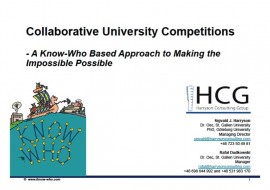
Download the introduction presentation (click the link or picture below)
Watch a video with John Bell (Head of Strategy and Partnerships at Philips Research) sharing his impressions from a joint project with HCG: click here
Nicolas Chanchevrier Head of Knowledge Management
AIRBUS S.A.S.
Knut-Magnar Aanestad Chief Knowledge Officer & Head of Information Technology
SCHJOEDT LAW FIRM
Edgar Moscoso Knowledge Manager
HOLCIM TECHNOLOGY LTD.
Christine Rübner Hultmann Head of Section, Global Knowledge Management
COWI A/S
Rob van der Spek Director, Knowledge Management Competence Centre
DNV GL
Charlotta Kronblad Knowledge Manager – Legal Department
AB VOLVO
Prof. Dr. Andreas Dengel Site Head & Scientific Director GERMAN RESEARCH CENTER FOR ARTIFICIAL INTELLIGENCE
A Knowledge Management vision enables an enterprise to create, share and explore knowledge to deliver true innovation in a dynamic environment. By deploying taxonomy and ontology it is possible to structure knowledge and collect the right metadata from internal and external sources. Innovation governance provides a company with capabilities to capture intellectual capital and transfer knowledge to spur innovation. To successfully manage taxonomies & ontologies – you need to create a web structure as simple as possible.
Collaboration is pivotal to explore ideas “outside” the company and drive growth to sustain a competitive business advantage in a global marketplace. Knowledge Management helps a company to organise huge masses of content and foster a corporate culture that promotes innovation. Change Agents implement KM strategies by building knowledge clusters to ensure a company reach beyond its innovation targets. Taxonomies & Ontologies represents a powerful tool for modeling complex business ecosystems. By combining taxonomy and ontology tools a company will be able to link computer systems together. Through company-wide web structures that manage transfer of the right metadata and knowledge-structures, companies are able to accelerate collaboration internally and with clients and partners. An innovation ecosystem handles knowledge activities to successfully translate ideas into innovation. To stay competitive companies, need to organise, share and exchange data and content, anytime and anywhere.
This pioneering flagship event will examine the best KM strategies to capture intellectual capital and build a collaborative organisation. Our cross-industry speaker panel provides your company with a roadmap to explore emerging cloud-based taxonomies, how to merge taxonomies and manage large-scale taxonomies. By attending Lab Innovator’s “Taxonomies & Ontologies” conference in Copenhagen, your organisation will be able to tailor end-to-end innovation processes to position your company as a true innovator in a dynamic environment.
Link to the organiser’s website: Labinnovator